Why “early signs” is a slightly misleading phrase
Age-related macular degeneration (AMD) damages the macula, the part of the retina responsible for sharp central vision. In its early stage there are typically no symptoms, according to the National Eye Institute (NEI). That’s the uncomfortable fact about AMD: by the time you notice, the disease has often advanced. Exams find it sooner (how often to get one).
Symptoms that do appear
| What you may notice | How it looks in daily life |
|---|---|
| Blurry area in the center of vision | Faces or words directly in front of you look smudged while the edges stay clear |
| Wavy or distorted lines | A door frame or tile line looks bent |
| Loss of central detail | Trouble reading, threading a needle or recognizing faces (NEI) |
| Dark or empty spot | A gap in the middle of what you’re looking at |
| Needing much more light | Reading becomes hard without bright light |
These symptoms aren’t proof of AMD, since other problems such as cataract and dry eye can blur vision too, but they’re reasons to be examined (match the cause to the fix).
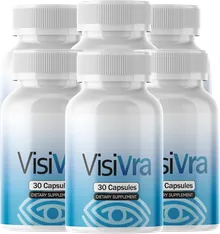
Best Visivra price today: 6 bottles at $49 each (save $780) or 3 bottles at $69 each with free US shipping. One-time payment, no autoship, 60 days to decide.
Check Today’s Discount ›A simple at-home check
With your usual glasses on, cover one eye and look at a straight line, such as a door frame or a grid pattern on a tile or window. Note whether lines look wavy, broken or blank, then check the other eye. Your eye doctor may give you a printed grid for regular checks. If something looks new, don’t wait for your next scheduled visit; the NEI notes that diagnosis is made with a dilated exam (NEI).
Who is at higher risk
- People over 50, with risk rising with age
- Smokers, current or past (NEI)
- People with a family history of AMD
- Those with cardiovascular risk factors such as high blood pressure
What treatment looks like
The NEI lists dietary supplements (vitamins and minerals), injections and photodynamic therapy as treatments, depending on the type and stage of AMD (NEI). The supplement piece is the AREDS2-style formula for intermediate AMD or advanced AMD in one eye (do eye vitamins prevent AMD?; AREDS vs AREDS2). Some forms of AMD need prompt injections, which is why new distortion shouldn’t be left.
Dry and wet AMD in plain language
| Dry AMD | Wet AMD | |
|---|---|---|
| How common | The majority of cases | Less common, but more often causes rapid loss |
| What happens | Gradual thinning and damage in the macula | Abnormal blood vessels leak under the retina |
| Speed | Usually slow | Can change quickly; needs prompt treatment |
| Treatment | AREDS2-style supplements for intermediate stage; monitoring | Injections and other treatments from a retina specialist (NEI) |
This is a simplified summary; your eye doctor will tell you which type and stage applies to you.
What to do this week
- Check each eye separately for wavy or missing areas, as described above.
- If you’re 50 or over and haven’t had a dilated exam recently, book one (schedule).
- If you smoke, make a quit plan; it’s the clearest modifiable risk (NEI).
- Ask relatives whether anyone had AMD.
Questions
Does AMD cause total blindness?
It affects central vision, not side (peripheral) vision, so people don’t usually lose all sight, but losing central detail can seriously affect reading, driving and recognizing faces (NEI).
Do I need to see a specialist?
Your eye doctor will refer you to a retina specialist if you need one, especially for wet AMD.
Can I still read with AMD?
Many people can with magnifiers, good lighting and low-vision aids. Ask your doctor about vision rehabilitation services.
Where a general eye supplement fits
A general formula doesn’t treat AMD. If you’ve been diagnosed, follow your doctor on supplements; if you haven’t, lutein and zeaxanthin simply support macular pigment as part of eye nutrition (JAMA). Visivra is one option that includes them (affiliate link), and our macular degeneration guide explains the limits. The most protective things you can do are not smoking and keeping your exam appointments.
FAQ
What are the first signs of macular degeneration?
Often there are none. Later signs include blurry or wavy areas in the central vision and loss of central detail.
Can you have macular degeneration without symptoms?
Yes. Early AMD usually has no symptoms and is found on a dilated eye exam.
Do I need to see a doctor right away if lines look wavy?
Yes, contact your eye doctor promptly. Some forms of AMD need treatment quickly.
Can supplements treat AMD?
Only specific AREDS2-style formulas, for people with intermediate AMD or advanced AMD in one eye, and under a doctor’s guidance.
Sources
- National Eye Institute (NIH): Age-related macular degeneration
- PubMed: Lutein + zeaxanthin and omega-3 fatty acids for AMD, the AREDS2 randomized trial (JAMA, 2013)
General information, not medical advice. Prices and product details come from the official Visivra order page and bottle, checked November 6, 2026; the checkout page and the label on your bottle take priority. Read our disclaimer.